

 English
 русский
 Español
Are You Interested?
Are You Interested?


Content
Specifying a high-temperature silicone rubber compound rarely fails because of the polymer. It fails because the fully formulated, ready-to-process material was never matched to the thermal, mechanical and electrical duty it will meet in service. Two compounds can carry the same headline temperature on a datasheet and still behave in completely different ways after 3,000 hours at 180 °C inside a cable that flexes every day, or after ten minutes inside a flame at 1,000 °C. The sections below work through what these compounds contain, which formulation levers change performance, why heat resistance and fire resistance are separate design targets, and how to specify, process and qualify the right material for cable insulation, cable sheathing, automotive high-voltage wiring and fire-resistant circuit components.
A silicone rubber compound sits at the junction of polymer chemistry and cable engineering. The base polymer provides the siloxane backbone that lets the material survive temperatures well beyond the range of most organic elastomers, but the base polymer alone satisfies no real application. What determines behaviour is the complete package: reinforcing filler, structure control additive, crosslinking system, heat stabilisers and processing aids.
That is why two compounds rated to the same temperature can behave differently in service. The difference appears first as hardening and loss of elastic recovery, then as surface cracking, and finally as electrical drift as the filler network and the polymer separate under repeated thermal cycles.
For a cable designer, the practical consequence is simple. A high-temperature silicone rubber compound should be bought as an engineered material with a defined duty, not as a generic raw material. The specification has to state the continuous temperature, the mechanical load, the electrical requirement and the fire scenario. Without those four inputs, any temperature claim on a datasheet is a starting point rather than an answer.
A ready-to-use compound is a formulated system rather than a single material. Four groups of ingredients do most of the work.
Methyl vinyl silicone gums are the standard choice for cable work because they balance flexibility, heat resistance and cure speed. Higher vinyl content generally raises crosslink density and hardness, while a higher gum content improves low-temperature flexibility and elongation at a higher cost.
Fumed silica delivers the highest tensile and tear strength and is the usual choice for dynamic and thin-wall insulation. Precipitated silica costs less, disperses differently and remains a sound option where dielectric performance and cost control matter more than tear resistance.
These additives stop the filler network from continuing to build during storage. Without them, a compound that leaves the mixer soft can become unprocessable a few weeks later, or it can lose the green strength needed for a stable extrusion profile.
Peroxide cure remains the most widely used route for cable insulation, while platinum addition cure is preferred for thin sections and low-volatile applications. Heat stabilisers and selected metal oxides slow the hardening that high temperature otherwise accelerates, and functional fillers such as mica, alumina or wollastonite support flame retardance or ceramic formation.
Heat resistance is not one number. A useful specification separates continuous service temperature, short-term peak temperature and the duration of that peak. A material that survives a 250 °C excursion for thirty minutes may still fail after four weeks at 180 °C.
| Compound family | Continuous service | Short-term peak | Typical cable use |
|---|---|---|---|
| Precipitated general purpose | -50 °C to 180 °C | up to 200 °C | Standard insulation and sheathing |
| Fumed high tear strength | -60 °C to 200 °C | up to 220 °C | Flexible control cable and harness |
| Flame retardant | -50 °C to 180 °C | up to 200 °C | Flame retardant cable builds |
| Ceramifiable | -60 °C to 200 °C | above 1000 °C in fire | Fire resistant and emergency circuits |
| Ceramifiable TPO | -40 °C to 125 °C | up to 150 °C | Cost sensitive fire resistant designs |
The values above are working ranges rather than guarantees. Actual performance depends on wall thickness, conductor loading, cycling pattern and the mechanical stress the cable sees, so every design should be qualified with aged samples rather than with a single fresh measurement.
Most specification debates come down to a small set of formulation decisions.
Compound selection should be driven by measured properties, not by a single temperature figure. The table below lists the indicators that most cable and component projects depend on, together with the test families normally used to confirm them.
| Property | Test family | Engineering meaning |
|---|---|---|
| Hardness | Shore A durometer | Assembly force, flexibility, sealing |
| Tensile strength | ASTM D412 or equivalent | Mechanical durability under load |
| Elongation at break | ASTM D412 or equivalent | Bending and handling performance |
| Tear strength | ASTM D624 or equivalent | Cut growth resistance during routing |
| Volume resistivity | ASTM D257 or equivalent | Insulation integrity |
| Dielectric strength | ASTM D149 or equivalent | Voltage withstand in thin walls |
| Oxygen index | ASTM D2863 or equivalent | Tendency to sustain combustion |
| Heat ageing retention | Air oven ageing at service temperature | Expected service life |
| Ceramic residue strength | Laboratory flame exposure | Circuit integrity under fire |
Fresh property data alone is not enough. Ageing retention data, measured on a cured sheet or on a finished cable, tells a designer whether the compound will still be inside its design window after several years of thermal cycling.
Flame retardance describes how a material resists ignition and limits flame spread. It is verified with tests that apply a flame for a defined period and then observe whether the sample self-extinguishes, how far it chars and whether burning material drips. A VW-1 rated compound is designed for exactly that duty.
Fire resistance asks a harder question: does the circuit keep working while the fire is still burning? A fire resistant cable has to survive mechanical shock and water spray after the insulation has been attacked. A material that merely resists ignition will not pass that test.
Designers therefore need to separate the two requirements early. If the goal is to stop a fire from spreading along a cable tray, flame retardant chemistry is the answer. If the goal is to keep an emergency circuit alive, the insulation has to transform into something structurally useful rather than simply resist burning.
 TC-9710 Ceramifiable Fire-Resistant Silicone RubberCeramic-forming silicone for fire-resistant cable insulation and sheathing, helping maintain circuit integrity by transforming into a rigid insulating shell under heat.View Product →
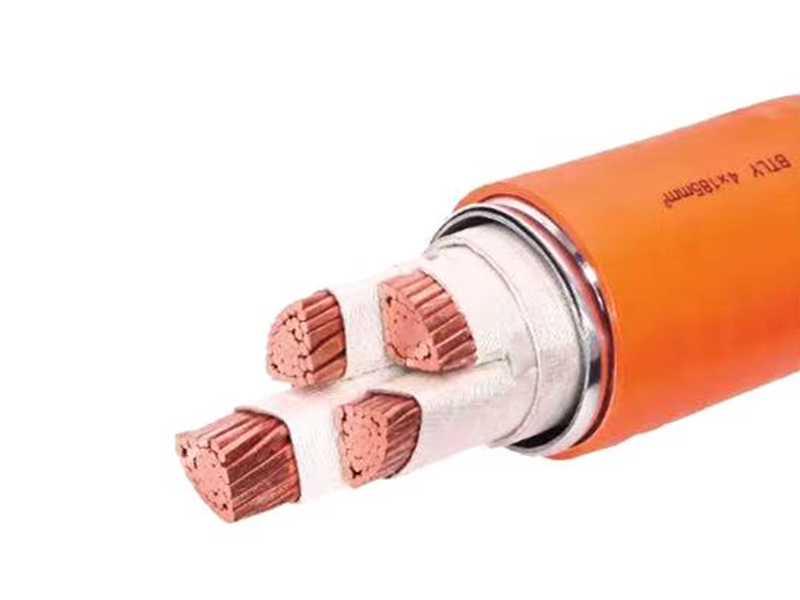
Ceramifiable compounds take a different route. At high temperature the silicone phase decomposes and the mineral fillers react and sinter, so the insulation becomes a rigid, insulating shell instead of crumbling away. That shell continues to separate the conductor from the outside world and absorbs heat, which is what keeps a circuit alive during a fire.
Three variables decide how well this works. The filler system must be selected so the ceramic forms at the right temperature with enough mechanical strength. The softening behaviour has to be controlled, because a shell that melts and flows will not hold position. And the mechanical design of the cable has to support the ceramic layer through shock and water spray tests.
Developers evaluating this class of material should request residue strength data from the compound supplier rather than relying on a temperature claim alone. A practical explanation of how a ceramifiable silicone rubber forms a protective ceramic shield is useful background before a qualification programme begins.
Processing determines whether a good formulation reaches its published properties. The diagram below shows the route most cable compounds follow, from incoming material to a cured insulation layer.
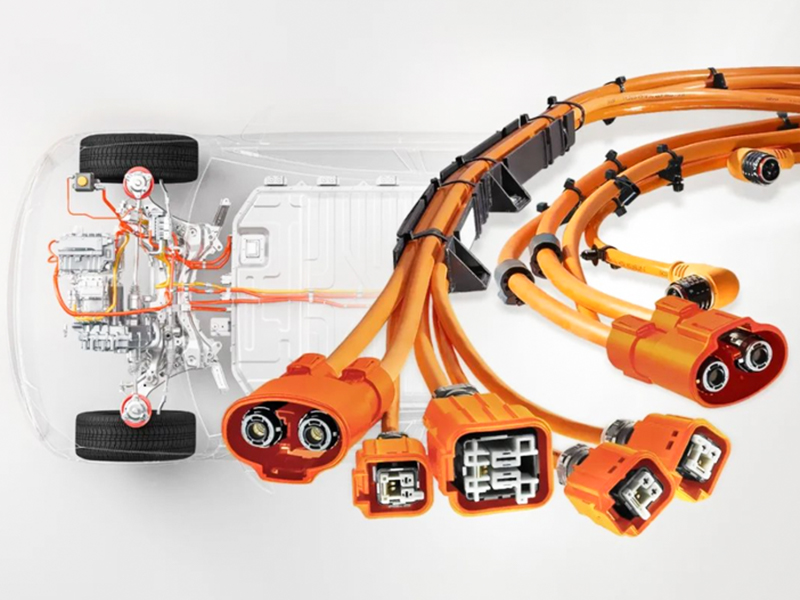 Automotive High Voltage EV Cable Silicone RubberHigh-voltage silicone insulation and jacketing for EV battery, charging, and powertrain cables, with UL94 V-0 flame resistance and EMI shielding options.View Product →
The application map for high-temperature silicone rubber compounds follows the temperature and safety demands of the cable or component.
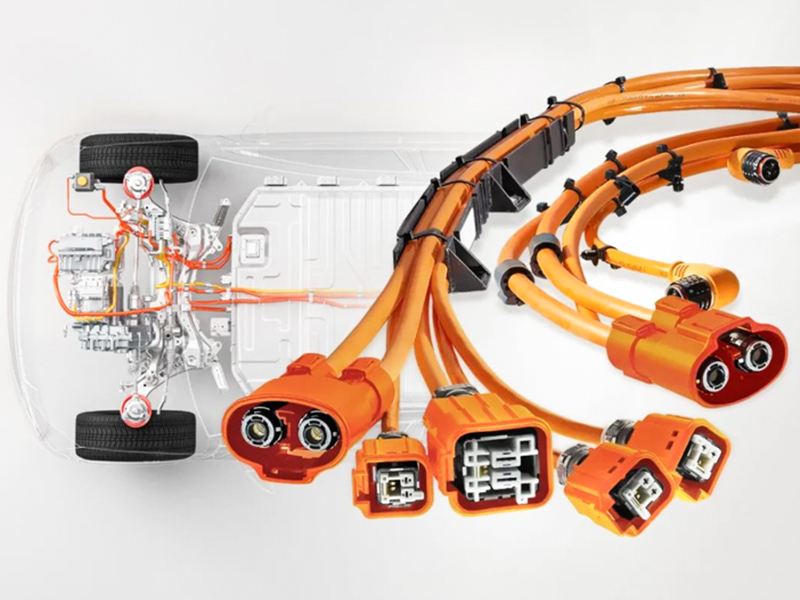
Automotive high voltage harnesses are a useful case to study because they combine continuous thermal load, flexibility and safety in a single design problem. The wider high temperature silicone rubber compound range for cable and industrial applications follows the same engineering logic, with the temperature class and fire requirement deciding the grade.
For cable manufacturers, compound quality is a production input rather than a laboratory curiosity. A supplier working to a recognised automotive quality management framework, such as IATF 16949, applies documented control over mixing parameters, incoming material and change management. That discipline is what keeps batch-to-batch hardness, cure rate and electrical properties inside a narrow band.
Three practical questions separate a reliable supplier from a merely responsive one. Can the supplier trace a finished compound back to the gum and filler lots used in it? Can they provide ageing retention data measured on the same formulation that is being quoted, rather than on a laboratory variant? And can they hold capacity through a demand spike without changing the formulation to speed up output?
On the material side, consistent feedstock matters as much as process. Suppliers that combine imported raw materials with domestic specialty grades generally gain stability in filler dispersion and cure behaviour, which is exactly where cable extrusion lines are most sensitive.
Most field failures trace back to a small number of recurring decisions rather than to a defective polymer.
A structured evaluation takes less time than a failed production run. Ask for the following before committing to a formulation.
Most cable grades work continuously between -50 °C and 200 °C, depending on the formulation. Precipitated general purpose compounds are usually designed around 180 °C, while fumed high tear strength grades reach 200 °C or slightly above. The real constraint is not temperature alone but the combination of temperature, time, mechanical load and electrical stress, so ageing retention data is far more useful than a single figure.
It can be, but the two functions are usually delivered by different formulations. A flame retardant grade limits flame spread and is verified with tests such as VW-1. A ceramifiable grade is designed to form a structurally useful ceramic shell at high temperature and to maintain circuit integrity through flame, shock and water spray. Many cable designs use both families, but in different layers of the construction.
Fumed silica has a much higher surface area and reinforces the polymer more effectively, so fumed compounds generally show higher tear strength, better compression set recovery and a smoother extruded surface. Precipitated silica costs less and still delivers good dielectric strength, which makes it suitable for general insulation and sheathing where tear resistance is not critical. At the same hardness, the two are not interchangeable.
Long-term heat exposure gradually raises crosslink density, so the material hardens and loses elongation. The key measure is how much tensile strength and elongation remain after ageing at the intended service temperature, for example after 1,000 hours at 200 °C. A well-formulated compound should retain a large share of its initial elongation, while a poorly stabilised one becomes brittle much earlier.
Look at three things: the temperature at which the ceramic shell forms, the mechanical strength of the residue after flame exposure, and the adhesion between the ceramic layer, the conductor and the outer sheath. The compound must also meet normal electrical and mechanical requirements before any fire occurs, because a cable spends almost all of its life in normal service.
Yes. Uncured compound continues to structure slowly, especially when stored warm or held for a long period. It can become harder and less easy to extrude, and the cure rate may drift. Storing material within the supplier's recommended conditions and using it inside the stated working window keeps extrusion and curing behaviour reproducible from one batch to the next.

What to stay up to date?
Contact us via the email address below.
No. 16, Industrial Concentration Zone, Daibu Town, Liyang City, China
Copyright 2026 Liyang Tiansheng Insulating Materials Co., Ltd. All Rights Reserved.
Custom Insulation Material For Cable Industry Suppliers

