

 English
 русский
 Español
Introduction: The Critical Role of Fumed Silicone Rubber in Advanced Industries In automotive turbocharging systems, medical devices, and aerospace sealing applications, material failure is not just an inconvenience—it ...
READ MORE

Custom Ceramized Thermoplastic Polyolefin (TPO) Cable Compound Manufacturers
About Us
Liyang Tiansheng Insulating Materials Co., Ltd.
Liyang Tiansheng Insulating Materials Co., Ltd. is China Custom Ceramifiable TPO Compound Manufacturers and Ceramized Thermoplastic Polyolefin (TPO) Cable Compound Suppliers, founded in 2013. It is a professional service provider dedicated to application solutions for flame‑retardant and fire‑resistant insulation materials, as well as thermal runaway solutions.
Boasting a strong technical team and more than 40 professional employees, Liyang Tiansheng produces technically mature products at an advanced industry level. The company serves the top ten cable manufacturers in China, including Jiangsu Shangshang, New Far East, and Hengtong Group.
Liyang Tiansheng focuses on promoting new‑type fire‑resistant silicone materials and silicone applications for aerospace, nuclear power, new energy vehicles, and related components. Its core business covers various special silicone rubber products for cable manufacturers. After years of steady development, the company now has an annual production capacity of 5,000 tons of various special silicone rubber and fire‑resistant insulation products, with annual sales exceeding 50 million yuan.
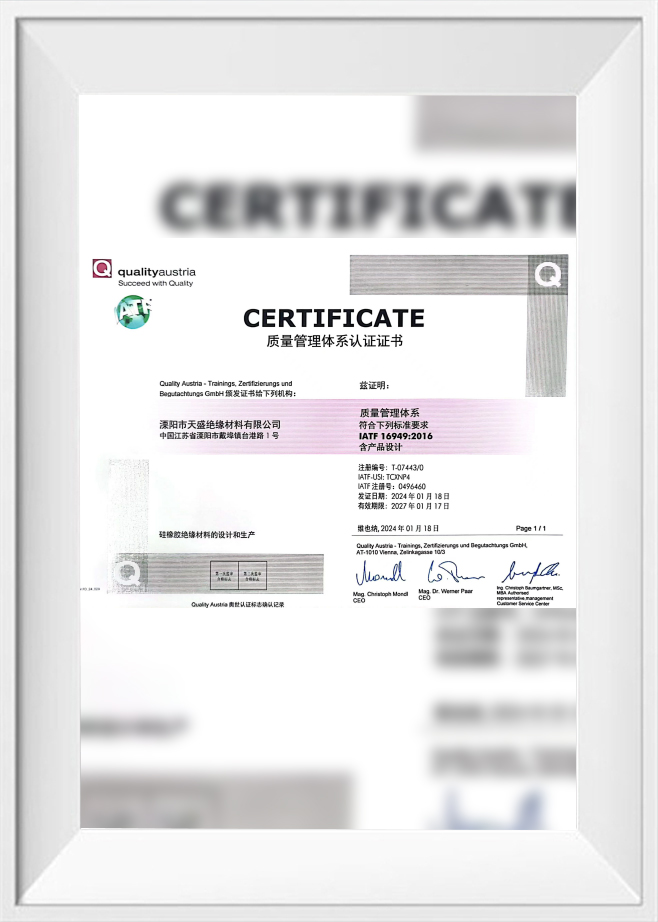
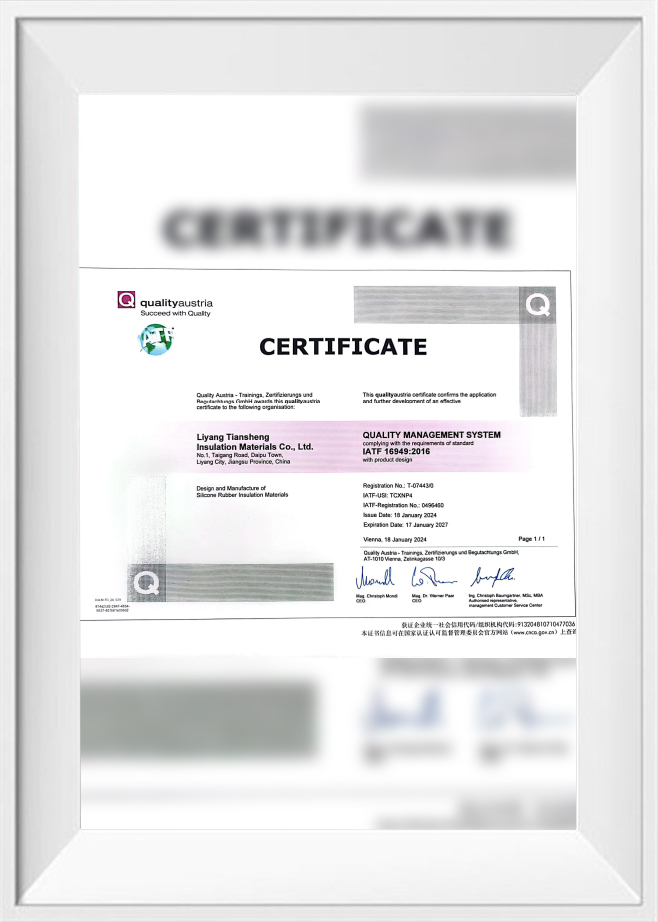
The company mainly uses high‑quality imported raw materials and specialized products from listed companies as its key production materials. Production processes are managed in accordance with the IATF 16949 new energy management system. Supported by extensive practical experience, a rigorous working attitude, and a complete testing system, the company ensures the quality of its products and services. Its professional and technical capabilities remain at the leading level among domestic counterparts. We offer Halogen Free TPO Cable Compound for sale.
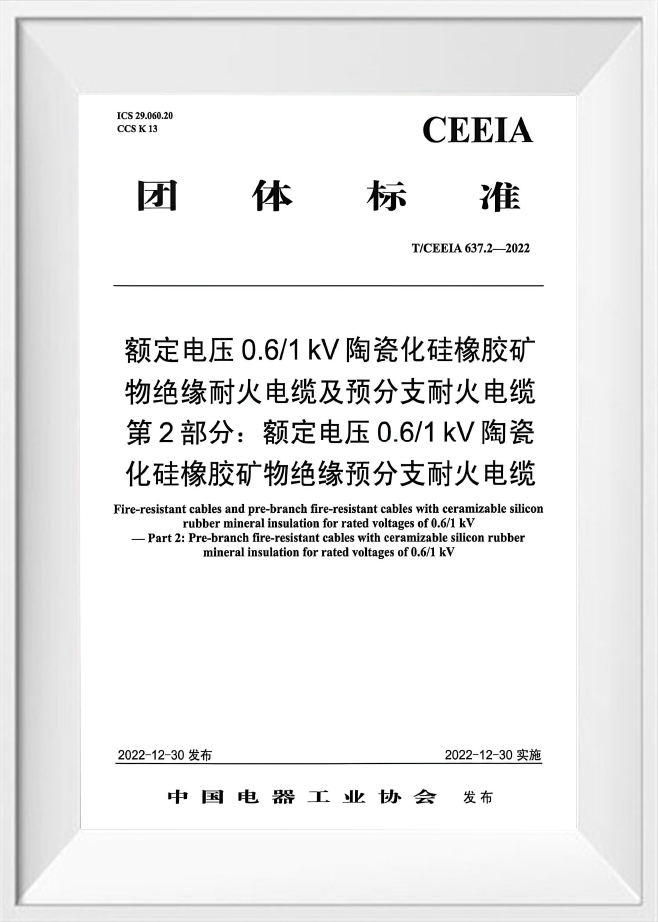
Certificate of Honor
News
-
-
Selecting a reliable silicone rubber supplier is one of the most critical decisions a manufacturer can make. The quality of your finished products depends directly on the materials you source, and this choice affects ev...
READ MORE -
Understanding Silicone Rubber Products and Their Market Presence Silicone rubber has become indispensable across countless industries due to its exceptional thermal stability, chemical resistance, and flexibility. From...
READ MORE -
Understanding Silicone Rubber Gaskets in Industrial Applications Silicone rubber gaskets have become essential components in modern industrial sealing solutions. These versatile materials offer exceptional performance a...
READ MORE
Ceramized Thermoplastic Polyolefin (TPO) Industry knowledge
What is the difference between ceramifiable TPO and ceramifiable silicone rubber?
Ceramifiable TPO compound and ceramifiable silicone rubber represent two distinct approaches to achieving fire-resistant protection in cable and electrical applications. Both materials share the unique ability to form a protective ceramic layer under high-temperature fire conditions, yet they differ fundamentally in their base polymer chemistry, processing methods, mechanical properties, and application suitability. This article examines the key differences between these two ceramifiable material families, providing guidance for engineers and procurement professionals selecting materials for fire-resistant cable systems. ceramized thermoplastic polyolefin (TPO) cable compound is one such material that offers distinct advantages in processing efficiency and cost-effectiveness. Liyang Tiansheng Insulating Materials Co., Ltd. has developed particular expertise in ceramifiable silicone rubber products, serving the top ten cable manufacturers in China including Jiangsu Shangshang, New Far East, and Hengtong Group. Its production processes are managed under the IATF 16949 new energy management system, ensuring consistent quality across its 5,000-ton annual production capacity.
1. Defining the Two Material Families
Halogen free TPO cable compound is a thermoplastic material based on polyolefin elastomers—typically blends of ethylene-octene copolymers, ethylene-vinyl acetate (EVA), and polypropylene—combined with ceramic precursors, fluxing agents, and halogen-free flame retardants. These ceramized thermoplastic polyolefin (TPO) cable compound materials are designed to be processed on conventional thermoplastic extrusion equipment, offering the processing efficiency and recyclability characteristic of thermoplastics. Upon exposure to high temperatures typically above 600°C, the ceramic precursors sinter together to form a protective ceramic layer that insulates the conductor and maintains circuit integrity during fire events. The company's professional and technical capabilities, supported by a rigorous working attitude and complete testing system, position it at the leading level among domestic counterparts.
In contrast, ceramifiable silicone rubber is an elastomeric thermoset material based on a silicone polymer (polydimethylsiloxane) backbone. The ceramifiable TPO compound differs fundamentally in that it is thermoplastic—it can be melted and re-melted—whereas silicone rubber undergoes irreversible crosslinking during curing. Silicone-based ceramifiable materials typically ceramify at lower temperatures, forming a ceramic shell under flameless high temperatures above 350°C or flame exposure above 600°C. This lower ceramification temperature gives silicone-based materials an advantage in certain fire protection scenarios. The company focuses on promoting new-type fire-resistant silicone materials for aerospace, nuclear power, and new energy vehicle applications, with annual sales exceeding 50 million yuan reflecting market recognition of these advanced solutions.
2. Comparative Analysis of Key Properties
Understanding the differences between ceramified thermoplastic polyolefin (TPO) cable compound and ceramifiable silicone rubber requires examining several critical performance dimensions.
2.1 Processing and Manufacturing Characteristics
Halogen free TPO cable compound offers significant processing advantages due to its thermoplastic nature. These materials can be extruded on standard thermoplastic lines at temperatures typically ranging from 110°C to 170°C. The extrusion process is straightforward, with conventional screw designs and tooling suitable for polyolefin processing. TPO compounds are supplied as free-flowing pellets and do not require pre-drying if stored properly. This processing efficiency translates to higher production speeds and lower manufacturing costs compared to thermoset alternatives.
Ceramifiable silicone rubber, conversely, requires specialized processing equipment. As a thermoset material, it must be cured after extrusion, typically through heat-activated peroxide or platinum-catalyzed addition reactions. This curing step adds time and complexity to the manufacturing process. The material is supplied as a millable gum or strip form rather than pellets, requiring different handling and feeding systems. However, the investment in specialized equipment is often justified by the superior performance characteristics of silicone-based materials in demanding applications. Liyang Tiansheng has optimized its production processes through extensive practical experience, ensuring efficient manufacturing of high-quality silicone compounds.
2.2 Mechanical and Physical Properties
Ceramified thermoplastic polyolefin (TPO) cable compound typically exhibits tensile strength of 5 MPa or higher and elongation at break of at least 70%. The specific gravity of these compounds is relatively high, typically 1.56–1.76 g/cm³, due to the significant loading of ceramic fillers and flame retardants required to achieve ceramification. The TPO matrix provides flexibility and toughness, though the high filler loadings can reduce tear strength and elongation compared to unfilled polyolefins.
Ceramifiable silicone rubber offers distinct mechanical advantages in certain applications. The silicone elastomer provides exceptional flexibility from -70°C to 200°C, maintaining elasticity and resilience across a wide temperature range. The base polymer's inherent flexibility is less compromised by the ceramic filler system, resulting in better tear strength and elongation retention compared to TPO compounds. Silicone's lower filler loading requirements for effective ceramification contribute to this mechanical advantage. For demanding dynamic applications involving frequent flexing, silicone-based materials often provide superior performance.
2.3 Fire Performance and Ceramification Behavior
Both material families achieve ceramification through similar mechanisms—the incorporation of glass-forming minerals and fluxing agents that sinter under high heat. halogen free TPO cable compound typically begins ceramification at temperatures around 600°C or higher, with the ceramic layer providing insulation and flame barrier properties. The oxygen index (LOI) of these compounds is typically 34% or higher, indicating excellent flame retardance. The materials are halogen-free and produce low smoke emissions, meeting stringent fire safety requirements for building and transit applications.
Ceramifiable silicone rubber offers a lower ceramification threshold, forming a protective ceramic shell under flameless high temperatures above 350°C or flame erosion above 600°C. This lower activation temperature can be advantageous in fire scenarios where temperatures rise gradually. Silicone-based materials also produce exceptionally low smoke and non-toxic emissions, achieving ZA1 smoke toxicity ratings. The ceramic layer formed from silicone maintains electrical insulation properties effectively, protecting conductors during fire events. Liyang Tiansheng has developed extensive expertise in optimizing the ceramification behavior of silicone compounds through careful selection of ceramic precursors and fluxing agents, using high-quality imported raw materials to ensure consistent performance.
Comparative Overview: Ceramifiable TPO vs. Ceramifiable Silicone Rubber
| Property | Ceramifiable TPO | Ceramifiable Silicone Rubber |
| Base Polymer Type | Thermoplastic polyolefin | Thermoset silicone elastomer |
| Processing Method | Conventional thermoplastic extrusion | Extrusion with thermal curing |
| Ceramification Temperature | Typically ≥600°C | ≥350°C (flameless) / ≥600°C (flame) |
| Temperature Range (Normal) | Limited by TPO matrix | -70°C to 200°C |
| Halogen-Free | Yes | Yes |
| Key Advantage | Processing efficiency, cost-effectiveness | Superior flexibility, wider temperature range |
3. Selecting the Appropriate Material
The choice between ceramifiable TPO compound and ceramifiable silicone rubber depends on the specific application requirements. halogen free TPO cable compound is generally preferred for high-volume, cost-sensitive cable applications where processing efficiency and recyclability are valued. These materials are widely used in building wire, transit cables, and general-purpose fire-resistant cables. The ceramified thermoplastic polyolefin (TPO) cable compound offers the advantage of established recycling infrastructure and lower material costs.
Ceramifiable silicone rubber is selected for demanding applications requiring superior flexibility, wider operating temperature ranges, and lower ceramification temperatures. It is particularly suitable for new energy vehicle battery systems, aerospace applications, and specialized industrial cables where both fire protection and mechanical durability are critical. The company has positioned itself as a leader in this segment, with its professional and technical capabilities enabling the production of advanced ceramifiable silicone compounds for demanding applications.
4. Frequently Asked Questions
Q1: Can ceramifiable TPO be processed on the same equipment as standard polyolefins?
Yes. Ceramifiable TPO compound can be processed on conventional thermoplastic extrusion equipment with typical temperature profiles of 110–170°C. The compound is supplied as free-flowing pellets and does not require special handling or pre-drying when properly stored.
Q2: Which material offers better flexibility for dynamic cable applications?
Ceramifiable silicone rubber offers superior flexibility and resilience, maintaining properties from -70°C to 200°C. The silicone matrix is less compromised by ceramic filler loadings compared to TPO, providing better tear strength and flex fatigue resistance for dynamic applications.
Q3: What quality standards does Liyang Tiansheng follow for its ceramifiable products?
Liyang Tiansheng Insulating Materials Co., Ltd. operates under the IATF 16949 new energy management system, maintaining a complete testing system to verify ceramification behavior and product quality. The company uses high-quality imported raw materials and employs a strong technical team of more than 40 professionals.
Q4: Are both material families halogen-free?
Yes. Both halogen free TPO cable compound and ceramifiable silicone rubber are halogen-free, producing low smoke and non-toxic emissions during combustion. This makes both materials suitable for applications where smoke toxicity is a critical safety concern.

Subscribe to Newsletters
What to stay up to date?
Contact us via the email address below.
Head office
No. 16, Industrial Concentration Zone, Daibu Town, Liyang City, China
Scan code
Email
lyts@lyts2023.com
Phone
+86-17625747685
Tel
+86-519-87902211
Copyright 2026 Liyang Tiansheng Insulating Materials Co., Ltd. All Rights Reserved.
Custom Halogen Free TPO Cable Compound Factory

Are You Interested?
Are You Interested?
