

 English
 русский
 Español
Are You Interested?
Are You Interested?


Content
Most cable insulation fails in fire for a simple reason: the polymer decomposes, chars, and cracks apart, leaving bare conductor exposed to short circuits within minutes. A Ceramifiable Silicone Rubber Cable is built to behave differently. Rather than simply burning away, the insulation compound is formulated with silicone rubber loaded with specific mineral fillers that react to heat instead of collapsing under it.
When flame temperature climbs past roughly 300 to 400 degrees, the organic portion of the silicone begins to volatilize, but the mineral fillers embedded in the compound start a fusion process. Between approximately 500 and 900 degrees, these fillers sinter together and form a continuous ceramic-like shell around the conductor. This shell is not a byproduct of failure; it is the designed end state of the material. The insulation is engineered to convert, not to vanish.
That conversion is what separates a fire-resistant cable from a fire-retardant one. Fire retardant compounds slow the spread of flame across a cable run. Ceramifiable insulation goes further: it changes state under heat and keeps functioning as an electrical barrier after the polymer itself has effectively ceased to exist as rubber.
The term "fire resistant cable" is used loosely in the market, so specification engineers rely on circuit integrity standards to separate genuine performance from marketing language. These standards do not just measure whether a cable burns. They measure whether the circuit continues to carry rated voltage and current while flame is actively applied.
Three families of test dominate specification work across construction, marine, and industrial projects:
| Standard Family | Core Requirement | Typical Flame Temperature |
|---|---|---|
| IEC 60331 Series | Circuit remains energized during and after flame exposure | 750 to 950 Degrees |
| BS 6387 Categories | Adds mechanical shock and water spray during burning | 650 to 950 Degrees |
| GB/T 19216 Series | Chinese national standard for fire survival cable performance | 750 to 950 Degrees |
Passing one of these tests is not a pass or fail on smoke or char alone. A monitoring circuit runs through the sample cable for the full duration, and any interruption in continuity, any short to earth, or any fuse trip is recorded as a failure. This is the mechanism that gives circuit integrity standards their teeth: the pass condition is functional, not cosmetic.
Fire survival cable testing is deliberately unforgiving. A sample of cable, typically several hundred millimeters long, is mounted horizontally or vertically over a ribbon burner or propane flame source. The conductors are wired into a monitoring circuit, often carrying the cable's rated voltage through a small lamp or relay so that any loss of continuity is visible in real time to the test operator.
The flame is applied continuously for the required duration while temperature at the flame front is tracked with thermocouples. For the more demanding categories, the rig adds a water spray directly onto the burning sample, or a mechanical impact hammer that strikes the cable at fixed intervals. The combination is designed to simulate what actually happens during a structure fire: heat, sprinkler discharge, and falling debris, all at once.
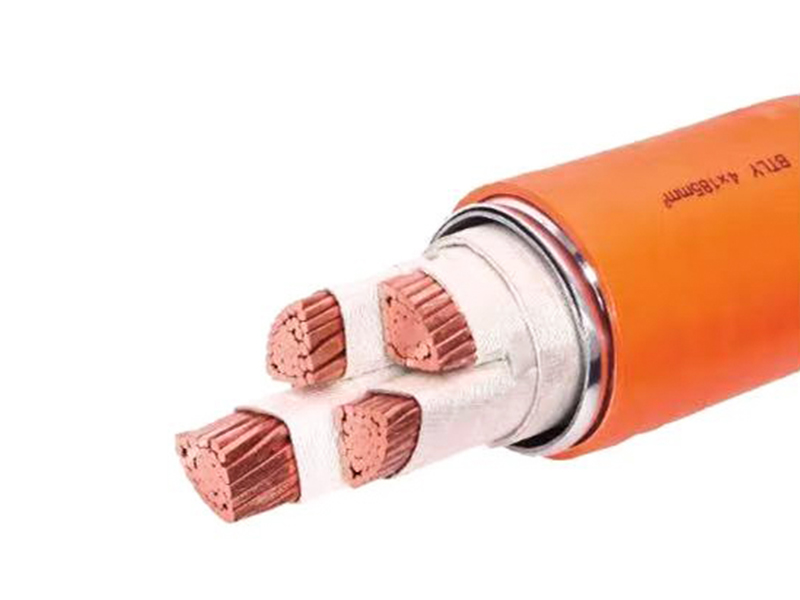
What separates ceramifiable silicone from conventional flame retardant compounds in this test is what remains after the organic material has burned off. A standard compound leaves a brittle char that a water jet or hammer strike will crack straight through, exposing bare conductor and ending the test. The ceramified shell, by contrast, has already fused into a continuous mineral layer before that stress is applied, so it holds its shape under impact and moisture rather than shattering.
It is a common misconception in early-stage specification that flame temperature resistance is the single number that matters. A compound can withstand a very high peak temperature and still fail circuit integrity testing if the char it forms cannot hold together under vibration, water impact, or the physical weight of the cable itself sagging in a cable tray. Temperature tolerance describes what the material survives; mechanical continuity of the char layer describes whether it keeps doing its job while surviving.
This is why comparative evaluation across insulation families needs to look at multiple performance dimensions together rather than any single spec sheet number.
The gap between the two profiles is largest not on raw temperature tolerance, where both compounds may perform reasonably, but on post-burn mechanical strength and impact resistance while still burning. Those two categories are exactly where standard compounds lose continuity during BS 6387 style hammer impact sequences, and where the ceramic shell earns its classification.
Residual ash strength refers to the mechanical integrity of whatever is left after the organic content of the insulation has combusted. For a conventional compound, that residue is often a loose, friable char that crumbles under light finger pressure. It offers almost no dielectric protection once physically disturbed, which is exactly what happens when a sprinkler head activates or a section of ceiling collapses onto a cable tray during a real fire.
Ceramifiable silicone insulation is formulated specifically so that its residual layer behaves differently. As the fillers sinter into a continuous mineral matrix, the resulting ash retains structural cohesion, it does not simply flake apart, and it continues to resist bending, cracking, and water penetration for the duration of the test and often well beyond it.
Circuit integrity performance is not an abstract laboratory exercise. It is specified because certain building and infrastructure systems are required by code to remain operational for a defined period after a fire starts, precisely so that people can evacuate and first responders can work safely. Emergency power supply wiring for these systems is one of the few places in a building where cable selection is directly tied to life safety outcomes rather than cost efficiency alone.
| System | Function During Fire | Typical Required Survival |
|---|---|---|
| Fire Pump Feeders | Maintains water pressure to sprinklers and hose systems | 120 minutes or more |
| Smoke Control Fans | Keeps stairwells and exit paths clear of smoke | 120 minutes or more |
| Emergency Lighting Circuits | Guides occupants to exits when normal power fails | 90 minutes |
| Voice Evacuation and Alarm | Delivers instructions during active evacuation | 120 minutes or more |
| Elevator Recall Control | Returns cars to ground level for firefighter use | 60 to 90 minutes |
In each of these applications, the cable is not expected to prevent the fire or even to survive undamaged. It is expected to keep the circuit closed long enough for the system it feeds to complete its job. That distinction is the entire design philosophy behind ceramifiable insulation: functional survival under active combustion, not cosmetic resistance to ignition.
Tunnel fires present a harder problem than open building fires because heat and smoke have nowhere to dissipate, and evacuation routes are longer and more exposed. Ventilation fans, emergency lighting strings, and communication wiring inside a tunnel bore need to keep operating precisely while the surrounding air temperature is climbing fastest. This is the environment where a Fire Resistant Silicone Rubber Cable For Tunnels is typically specified over general-purpose fire retardant alternatives, because the mechanical shock and prolonged high temperature exposure inside a tunnel incident more closely match the harsher circuit integrity test categories rather than the basic flame-only classifications.
Tunnel specifications also tend to add halogen-free and low smoke requirements on top of circuit integrity, since toxic gas buildup in a confined space is itself a major hazard to both evacuating occupants and emergency crews. Ceramifiable silicone compounds are commonly formulated halogen-free by default, which lines up naturally with these combined requirements rather than requiring a separate compound trade-off.
For engineers reviewing a cable schedule or a contractor submittal, a few checks separate a genuinely tested product from one relying on generic marketing claims.
A Ceramifiable Silicone Rubber Insulated Fire-Resistant Cable earns its classification through this combination of documented flame temperature resistance, residual ash strength, and verified circuit continuity under load, not through any single headline number on a datasheet.
Testing typically applies flame in the 750 to 950 degree range for the required duration, and the ceramified layer is designed to remain structurally intact through that range rather than failing at a lower threshold.
No. Fire retardant compounds are designed mainly to slow flame spread along a cable run. Ceramifiable insulation is designed to actively convert into a ceramic barrier that keeps the circuit functioning while flame is present, which is a functional performance requirement rather than a spread-limiting one.
No. Circuit integrity testing accepts visible charring and surface damage. The pass condition is continuous electrical continuity at rated voltage through the monitoring circuit for the full test duration, not cosmetic condition afterward.
Because during an active fire, water spray from sprinklers and mechanical shock from falling debris happen while the cable is still burning, not after. A weak, crumbling char fails at that moment, which is exactly what the water spray and impact test categories are designed to catch.
They are most commonly specified where codes require guaranteed circuit survival time, which includes commercial high-rises, tunnels, transit infrastructure, marine vessels, data centers, and industrial facilities with emergency shutdown or ventilation systems.

What to stay up to date?
Contact us via the email address below.
No. 16, Industrial Concentration Zone, Daibu Town, Liyang City, China
Copyright 2026 Liyang Tiansheng Insulating Materials Co., Ltd. All Rights Reserved.
Custom Insulation Material For Cable Industry Suppliers

